Resources

What 34 minutes on PMAC actually produces.

Sample artifacts, methodology explainers, and original POV from the team building PM Agent Chain. More publishing through May 2026 as we onboard pilot customers.

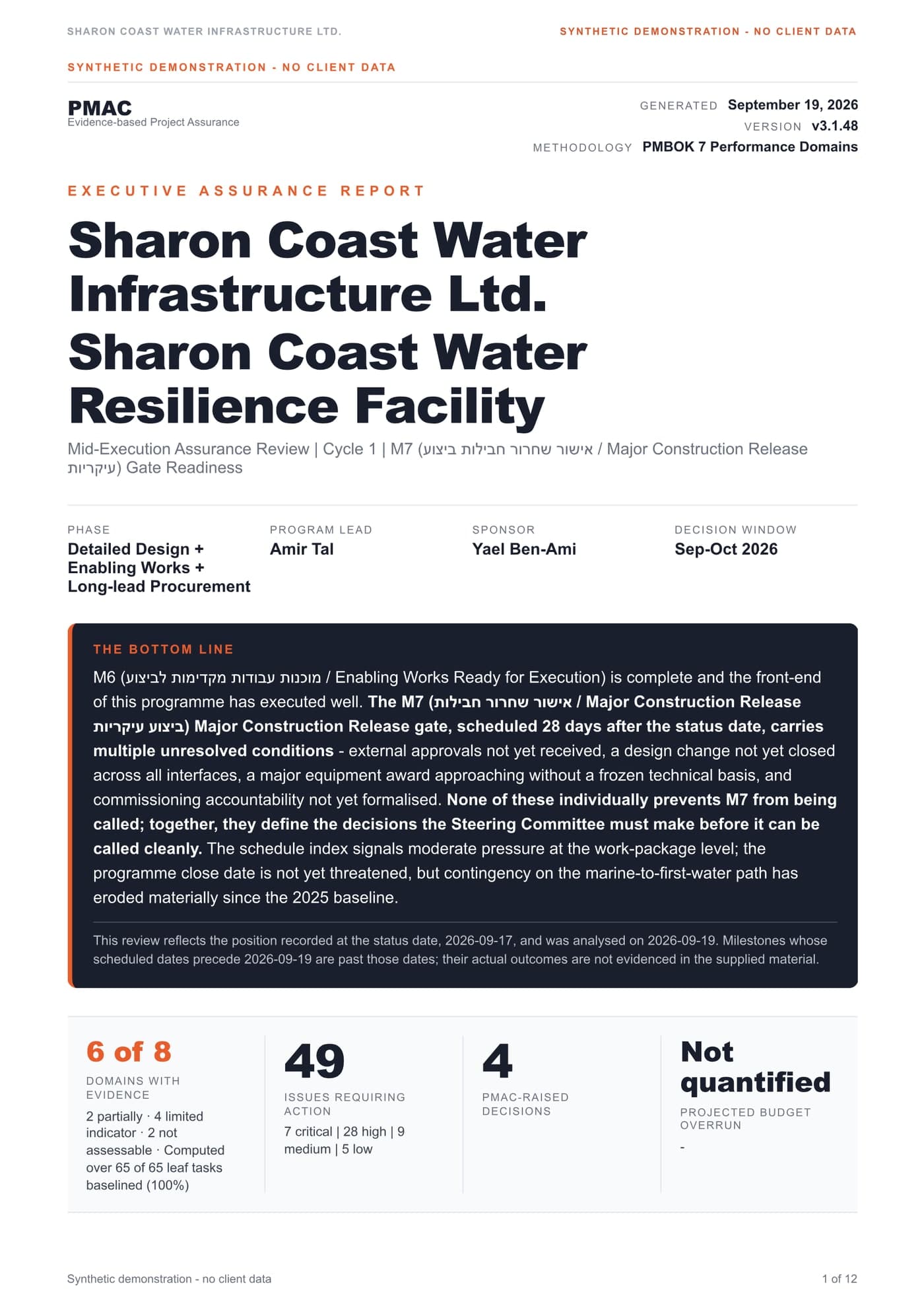
Project Charter cover: Apex Data Center Greenfield Build (PM Agent Chain sample artifact)

Sample artifact

Project Charter: Apex Data Center Greenfield Build

A complete Project Charter generated by PM Agent Chain from a synthetic data center construction brief. 7 pages, 13 PMBOK sections, native Word formatting with branded cover, page chrome, and embedded source-verification QR code. Generated in approximately 34 minutes alongside 41 other artifacts spanning the full PMBOK lifecycle.

7
Pages
13
PMBOK sections
.docx
Native format
~34 min
Generated alongside 41 other artifacts

Apex Data Center is a synthetic project pattern used for platform development and benchmarking. No real customer data is used.

How it works

The 7-agent pipeline

Agent PipelineSequential · ~34 min end-to-end
0Agent 0
Brief Assessor
Pre-flight
1Agent 1
Initiating
Charter · Stakeholders · Risk
2Agent 2
Planning
Scope · Schedule · WBS
3Agent 3
Executing
Communications · Procurement
4Agent 4
Monitoring
Quality · Performance
5Agent 5
Validating
Quality Rubric Grading
6Agent 6
Closing
Synthesis · Executive Summary
Each agent’s output feeds the nextPMBOK 7th Edition alignedNative .docx / .pptx / .xlsx

Each agent in PM Agent Chain corresponds to a PMBOK process group and reads the prior phase’s complete output before generating its own. This sequential dependency is the institutional logic of project management. And it is what produces artifacts that survive PMO audit.

Methodology · April 2026

Why we run every research question through three AI engines

When researching the AI project management landscape (competitive players, methodology approaches, customer adoption patterns), we noticed a recurring problem: each AI engine has distinct biases that systematically distort what it surfaces. Claude favors established, well-documented players. ChatGPT favors small and active recent entrants. Gemini favors regional and culturally specific results.

The fix turned out to be simple: run identical prompts across Claude, ChatGPT, and Gemini in parallel. The union of three independent searches consistently outperforms any single engine. Two-engine consensus is high-confidence. Three-engine consensus is decisive.

When we needed to verify there is no competitor producing a complete native-file PMBOK lifecycle from a single brief, we ran the question through all three engines. The union returned 571 distinct sources. The independent confirmation across all three was decisive. And it is the methodology we recommend to any PMO conducting their own AI vendor evaluation.

If you are evaluating AI project documentation platforms, the same triangulation applies. Run your shortlist questions through multiple engines. Trust the consensus, not the loudest voice.

More resources publishing through May 2026 as we onboard pilot customers.